Traditional Canes from the Solomon Islands
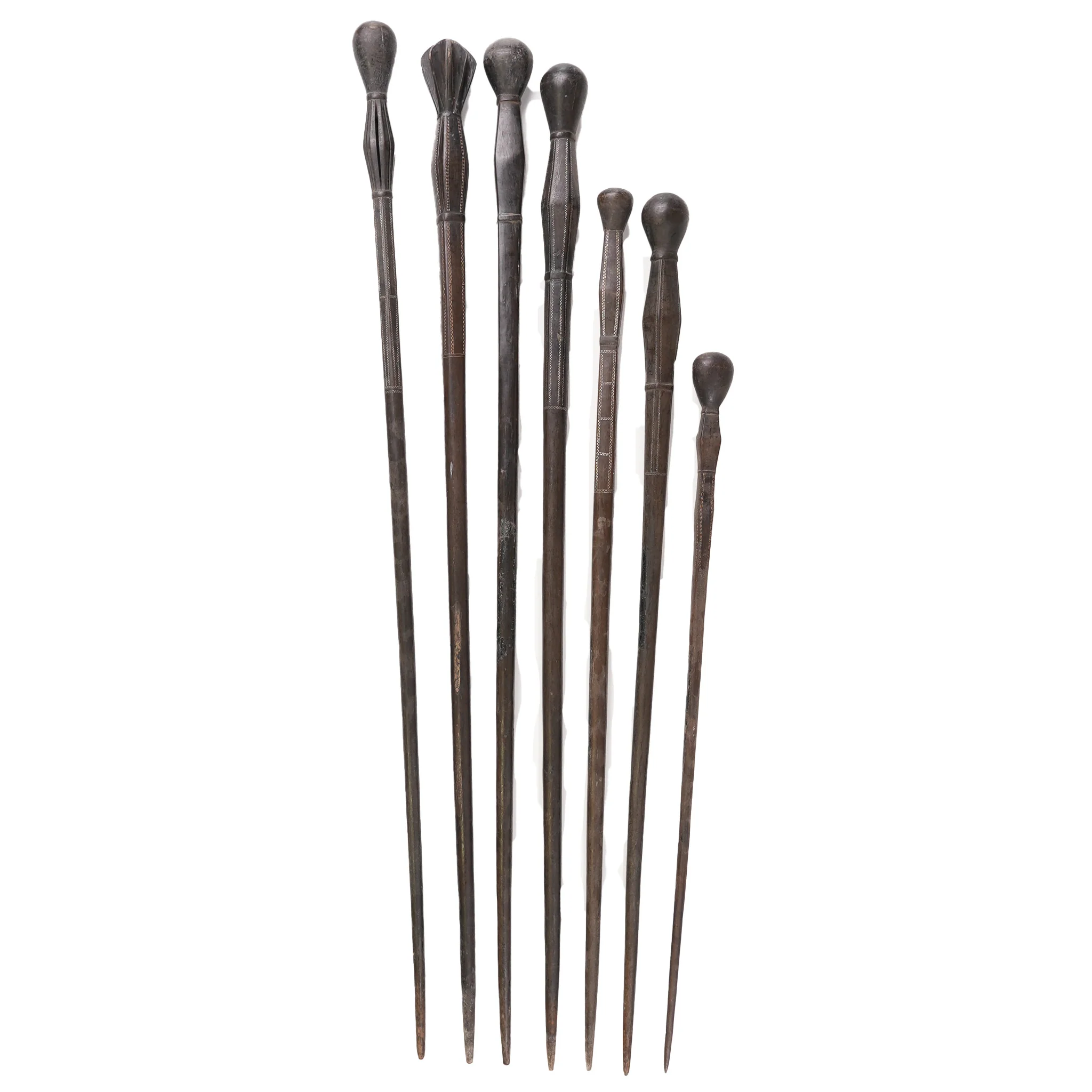
Lovers of history and ethnographic artifacts should check out this grab bag, certainly out of the ordinary for AP. This collection of canes appears to hail from the Solomon Islands. For scale, the largest item imaged comes in at roughly 41" in length, while the smallest measures about 28". These pieces come in various states of repair, but certainly aren't museum grade. They are likely no older than the twentieth century, but are neat pieces nonetheless.
The History:
The Solomon Islands are situated southeast of New Guinea; the areas of Bougainville, Nissan, and Buka are notable for their cultural separation from New Guinea, reflected in almost all aspects of their culture and artifacts. Generally, the art from the Solomon Islands ranges as far as the many languages spoken across the islands. Of the 67 language groups, the objects produced are defined by their specific tribe of origin as well as their place in time. Generally, the more detailed a craft piece is, the more likely it is that the item is a tourist piece, typically in the form of a statue. The specific geometric details of these pieces, along with the nature of the woven/peal inlaid designs, seem to tie them to these cultures.
Product Information
Product Information
Shipping & Returns
Shipping & Returns
Traditional Canes from the Solomon Islands
Traditional Canes from the Solomon Islands
Lovers of history and ethnographic artifacts should check out this grab bag, certainly out of the ordinary for AP. This collection of canes appears to hail from the Solomon Islands. For scale, the largest item imaged comes in at roughly 41" in length, while the smallest measures about 28". These pieces come in various states of repair, but certainly aren't museum grade. They are likely no older than the twentieth century, but are neat pieces nonetheless.
The History:
The Solomon Islands are situated southeast of New Guinea; the areas of Bougainville, Nissan, and Buka are notable for their cultural separation from New Guinea, reflected in almost all aspects of their culture and artifacts. Generally, the art from the Solomon Islands ranges as far as the many languages spoken across the islands. Of the 67 language groups, the objects produced are defined by their specific tribe of origin as well as their place in time. Generally, the more detailed a craft piece is, the more likely it is that the item is a tourist piece, typically in the form of a statue. The specific geometric details of these pieces, along with the nature of the woven/peal inlaid designs, seem to tie them to these cultures.
Original: $119.99
-65%$119.99
$42.00Product Information
Product Information
Shipping & Returns
Shipping & Returns
Description
Lovers of history and ethnographic artifacts should check out this grab bag, certainly out of the ordinary for AP. This collection of canes appears to hail from the Solomon Islands. For scale, the largest item imaged comes in at roughly 41" in length, while the smallest measures about 28". These pieces come in various states of repair, but certainly aren't museum grade. They are likely no older than the twentieth century, but are neat pieces nonetheless.
The History:
The Solomon Islands are situated southeast of New Guinea; the areas of Bougainville, Nissan, and Buka are notable for their cultural separation from New Guinea, reflected in almost all aspects of their culture and artifacts. Generally, the art from the Solomon Islands ranges as far as the many languages spoken across the islands. Of the 67 language groups, the objects produced are defined by their specific tribe of origin as well as their place in time. Generally, the more detailed a craft piece is, the more likely it is that the item is a tourist piece, typically in the form of a statue. The specific geometric details of these pieces, along with the nature of the woven/peal inlaid designs, seem to tie them to these cultures.